If you own an oil-heated home on Long Island, you’ve probably heard the pitch: convert to gas and save money forever. The reality is more complicated, and the oil heat vs. gas heat pros and cons for Long Island homes look very different depending on where you live, what you currently pay per gallon, and whether natural gas even reaches your street. Natural gas service isn’t available on every block in Nassau and Suffolk County, and conversion costs can run well into five figures. Before you call a contractor, you need actual 2026 numbers, not national averages or a salesperson’s estimate. This article breaks down the real tradeoffs: fuel prices, efficiency differences, full conversion costs, and the local infrastructure realities that determine whether gas is even an option for your home. The decision comes down to where you live, what you use, and what conversion costs you out of pocket.
The Case for Oil Heat on Long Island
For a significant portion of Long Island homeowners, the oil-versus-gas question has an obvious answer before the math even starts. Large parts of Suffolk County, particularly on the East End, including most of the Hamptons, the North Fork, and sections of Brookhaven, have no natural gas service at the street level, according to National Grid’s service area guidance. Without gas at the curb, hookup costs can add thousands to an already expensive conversion. For those homes, heating oil isn’t a lifestyle preference; it’s the practical reality short of switching to electric resistance heat or a heat pump system.
Heating oil delivery on Long Island is straightforward. You order when you need it, a local driver fills your tank, and there’s no utility infrastructure to negotiate. With Long Island heating oil averaging $5.22 to $5.42 per gallon in 2026, homeowners who shop locally and buy from a competitive supplier significantly narrow the annual cost gap with gas. A 1,500 to 2,000 square foot home typically uses 700 to 900 gallons per year, a range that reflects differences in insulation quality, thermostat habits, and winter severity, so locking in the right per-gallon rate matters considerably over the course of a season. Oil Prices Long Island serves Nassau and Suffolk County with competitive per-gallon pricing, cash-on-delivery payment, and no long-term contracts required.
Where Natural Gas Has a Clear Advantage
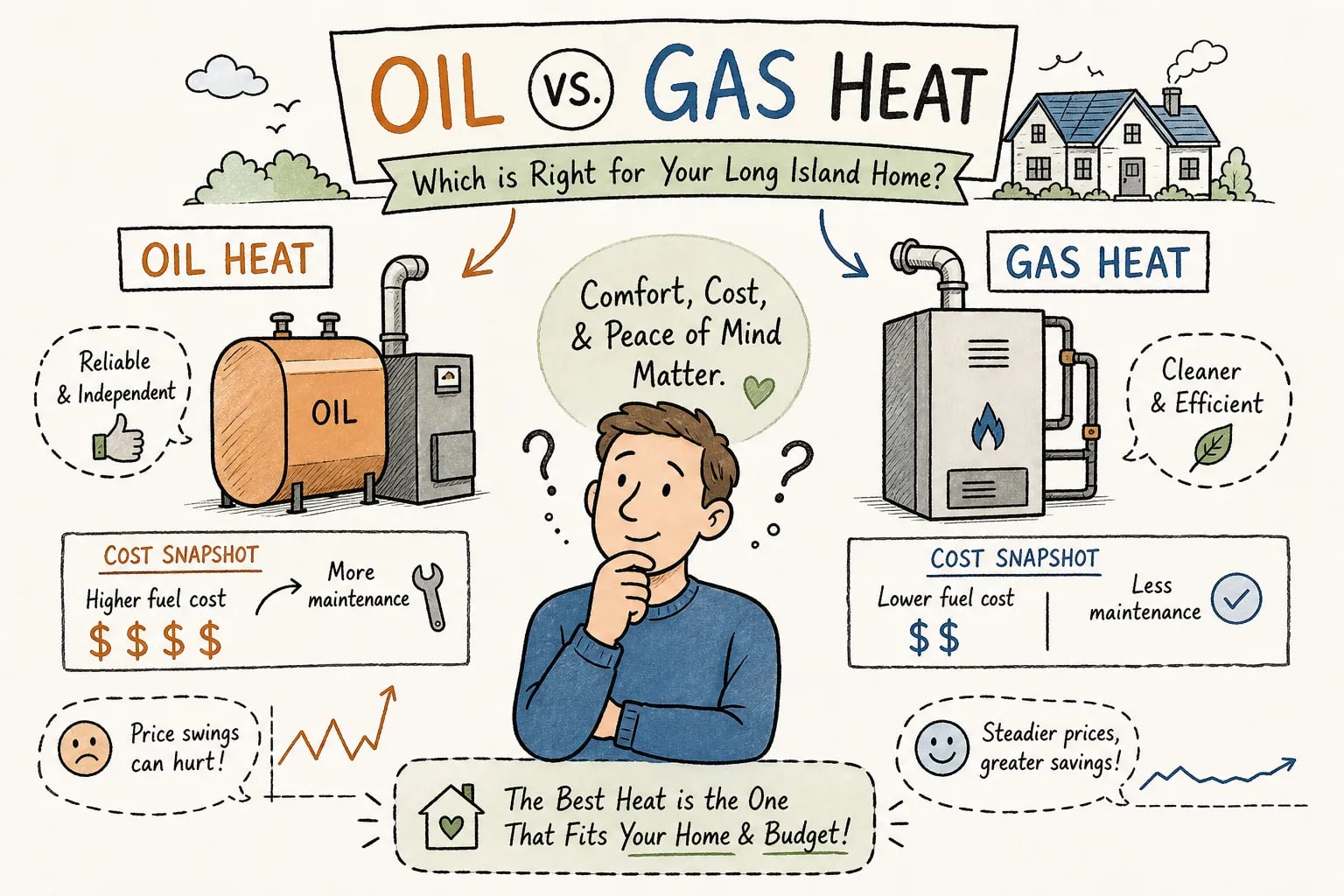
On a pure cost-per-BTU basis, natural gas wins in New York. Heating oil at $5.40 per gallon costs roughly $38.90 per million BTUs delivered. Natural gas at National Grid’s 2026 residential rate of 96.23 cents per therm works out to about $9.60 per million BTUs. That’s a wide gap, and it doesn’t disappear even when you factor in efficiency differences between the two fuel types.
Standard oil boilers and furnaces typically operate at 83 to 87 percent AFUE, meaning 13 to 17 cents of every fuel dollar goes out the flue. Condensing gas furnaces and boilers routinely hit 90 percent AFUE and above, delivering more usable heat per dollar of fuel. Combined with the lower cost per BTU, a well-installed gas system in a home with existing street-level gas service will generally produce lower annual heating bills. The average monthly gas heating bill in 2026 for roughly 83 therms of usage runs about $183, based on National Grid’s published residential rate schedule for this period.
Gas also removes the logistics of oil delivery: no tank gauge to monitor, no scheduling deliveries ahead of a storm, and no risk of running dry in February when roads are icy and delivery slots fill up fast. For homeowners who find those tasks stressful, the quality-of-life difference is worth factoring in alongside the hard numbers.
What Oil-to-Gas Conversion Actually Costs on Long Island
The total cost of converting from oil to gas on Long Island typically falls between $9,000 and $18,000, based on local contractor estimates and NYSERDA regional project data. A straightforward job, where gas is already at the curb and tank removal is simple, can come in around $8,000 to $12,000. More typical conversions, including line hookup, new equipment, permits, and oil tank removal, run $12,000 to $18,000. Complex jobs involving underground tank removal or longer gas runs can push past $18,000. Those costs break down across four main categories:
- Gas service hookup and line work: $1,500 to $5,000
- New gas furnace or boiler: $4,500 to $14,000 depending on equipment and efficiency tier
- Permits and inspections: $200 to $1,000
- Oil tank removal: $300 to $3,000 for above-ground tanks; $1,500 to $5,000 or more for underground tanks
On the incentive side, be realistic about 2026. The strongest Long Island rebates are for heat pump installations, not oil-to-gas conversions. PSEG Long Island heat pump rebates range from $4,000 for market-rate homes to $7,500 for low-income households, per PSEG Long Island’s current program schedules. For a direct oil-to-gas switch, incentives are thin: the “Upgrade and Save” program offers up to $500 for installing a higher-efficiency oil system, but there’s no comparable major rebate for gas conversion. Verify current program availability directly with your utility before signing any contractor agreement.
A Simple Payback Scenario
Consider a typical Nassau County homeowner burning 850 gallons of oil per year at $5.32 per gallon (the midpoint of the 2026 range). That’s roughly $4,522 in annual fuel costs. A comparable gas system, at National Grid’s current rate, might reduce that bill by $1,200 to $1,800 per year depending on equipment efficiency and usage. At a $15,000 conversion cost and $1,500 in average annual savings, the payback period is roughly ten years. If the job comes in at $10,000 and savings reach $1,800 annually, payback drops to about five to six years. Running this math for your specific address, usage history, and contractor quote is the most important step you can take before committing.
Comparing Oil vs. Gas Heat for Long Island Homes: Key Numbers at a Glance
| Factor | Heating Oil | Natural Gas |
|---|---|---|
| 2026 fuel price (Long Island) | $5.22, $5.42/gallon | $0.9623/therm (National Grid) |
| Cost per million BTUs | ~$38.90 | ~$9.60 |
| Typical AFUE range | 83, 87% | 90, 98% |
| Avg. annual fuel cost (850 gal/yr equivalent) | ~$4,522 | ~$2,700, $3,200 (est.) |
| Conversion cost | N/A | $9,000, $18,000+ |
| Payback period (typical) | N/A | 5, 12 years |
How to Decide Which Fuel Is Right for Your Home
Start with one question: is natural gas currently available on your street? Check the National Grid service map for your address before spending any time on cost comparisons. If gas isn’t at the curb, your conversion cost climbs immediately, and the payback math changes significantly. Many Long Island homeowners discover at this step that gas simply isn’t an option without a major infrastructure investment.
If gas is available, run the actual numbers for your home. At current oil prices, a home burning 850 gallons per year spends roughly $4,522 annually on fuel (at $5.32 per gallon, the midpoint of the 2026 range). A comparable gas system might deliver $1,200 to $1,800 in savings per year, but a $15,000 conversion takes many years to break even. If you’re planning to sell within five to seven years, the return on that investment is uncertain and depends heavily on what buyers in your neighborhood expect.
For seniors, fixed-income households, or anyone without the upfront capital for a full conversion, staying on oil with a competitive local supplier is a financially sound long-term decision. The annual cost gap narrows considerably when you’re buying heating oil at the lowest available per-gallon rate with no contract locking you into inflated pricing. When you weigh the pros and cons of oil vs. gas heat for Long Island homes, the right answer is rarely the same for every household.
The Bottom Line for Long Island Homeowners
Neither fuel is universally better. The pros and cons of oil heat vs. gas heat for Long Island homes ultimately depend on three things: whether gas service reaches your address, whether your annual savings justify the conversion cost, and how long you plan to stay in the house. Gas has a real cost-per-BTU advantage, but that advantage only matters if service is accessible and the conversion investment pays back in a reasonable timeframe. For the large share of Long Island homeowners without street-level gas service, or those without the capital for a $12,000-plus project, oil heat managed with the right supplier remains a practical, affordable choice.
Before calling any contractor, check your gas availability, estimate your annual cost under both scenarios, and calculate an honest payback period. If oil heat is your path forward, make sure you’re paying a competitive rate. Oil Prices Long Island serves Nassau and Suffolk County with competitive per-gallon prices, COD payment, and no long-term contracts, a straightforward option for homeowners who want to stay on oil without overpaying.