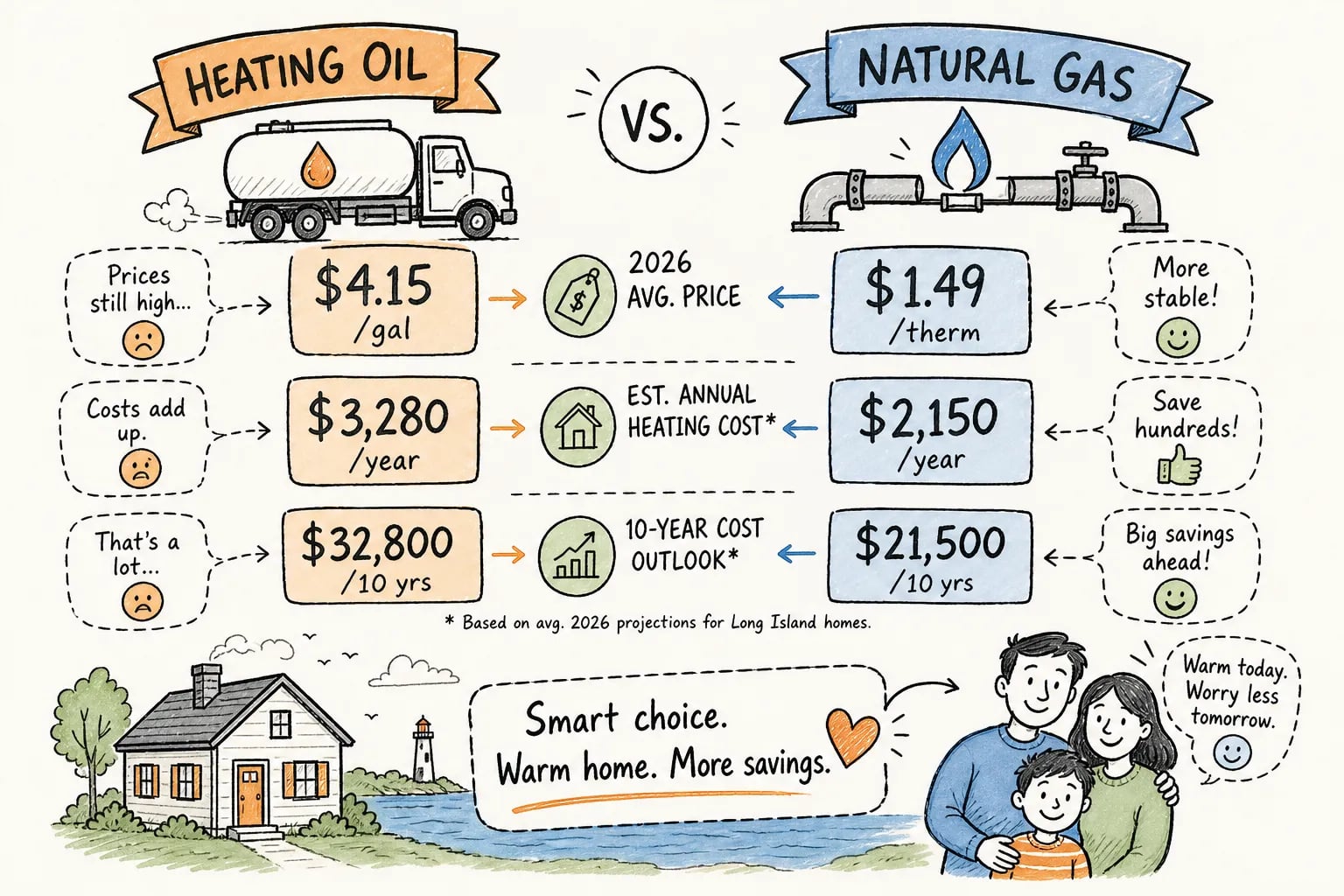
Every fall, Long Island homeowners with oil heat face the same question: is natural gas actually cheaper? This heating oil vs. natural gas cost comparison for Long Island, NY uses the 2026 NYSERDA regional average of $5.22 per gallon for #2 heating oil and National Grid’s September 2026 residential rate of approximately $0.48 per therm to show your actual annual costs. Those numbers do not belong side by side without real math connecting them, and this article runs that math using local data so you can make the right call for your home. At Oil Prices Long Island, we track these numbers daily across Nassau and Suffolk County, and the comparison is more nuanced than most homeowners expect.
Heating Oil vs. Natural Gas Cost Comparison, Long Island, NY (2026)
2026 heating oil prices: what you are paying per gallon
The NYSERDA June 2026 survey puts the Long Island regional average at $5.22 per gallon for #2 heating oil, covering Nassau and Suffolk counties combined. Live retail prices range from about $4.60 to $6.01 per gallon depending on your supplier and ZIP code, based on local price-tracking data. That $1.41 spread is significant: a homeowner burning 900 gallons per year pays anywhere from $4,140 to $5,409 annually based on nothing more than who they call.
National Grid gas rates for Long Island in 2026
For residential customers on service classes SC 1, 2, 3, and 17, the National Grid September 2026 rate is $0.476775 per therm. In January 2026, those same customers paid $0.721454 per therm. Gas pricing swings more than most homeowners realize. Unlike oil, your monthly bill bundles supply, delivery, and distribution charges together rather than quoting a single per-unit price you can shop and compare, a structure that makes an apples-to-apples fuel cost comparison harder to run without doing the underlying math.
Why a direct price-per-unit comparison misleads you
One gallon of #2 heating oil contains about 138,500 BTU. One therm of natural gas contains about 100,000 BTU. Putting $5.22 against $0.48 without accounting for that energy difference gives you a distorted picture. Equipment efficiency, measured by the AFUE rating, adds another layer: the cost per usable BTU actually delivered to your living space is the only figure that gives you a fair comparison, and the next section calculates that for a typical Long Island home.
Annual Cost Comparison for Long Island Homes: Oil vs. Gas
Running the math for a 2,000 sq ft home
A 2,000 square foot home in Nassau or Suffolk County typically burns 800 to 1,000 gallons of heating oil per year. At the 2026 average of $5.22 per gallon, that puts annual oil costs between $4,176 and $5,220. A comparable gas-heated home of the same size uses roughly 1,100 to 1,300 therms annually (an estimate based on typical Long Island usage patterns for homes in this size range).
Using a blended rate weighted across the heating season, applying the January 2026 rate of $0.721454 per therm to peak winter months and the September 2026 rate of $0.476775 per therm to shoulder months, produces a weighted average of approximately $0.57 per therm. At that blended rate, 1,100 to 1,300 therms yields estimated annual gas costs of roughly $627 to $741. The annual savings potential compared to oil is real, but it does not exist in your pocket until you have paid back the conversion investment.
How equipment efficiency affects your real-world numbers
An older 80% AFUE oil boiler wastes 20 cents of every fuel dollar up the flue. A new 95% AFUE gas condensing boiler captures nearly all of it. If you are comparing your aging oil system against a brand-new high-efficiency gas installation, those are not equal conditions. A high-efficiency oil burner narrows that efficiency gap considerably, so the equipment on both sides of the comparison matters as much as the fuel price itself.
What Oil-to-Gas Conversion Actually Costs on Long Island
A realistic breakdown of conversion expenses
Most Long Island oil-to-gas conversions come in between $12,000 and $15,000 for a straightforward project, based on aggregated local contractor estimates. The main cost buckets are:
- Gas line extension from the street: $1,500 to $5,000
- New boiler or furnace, installed: $4,000 to $14,000
- Permits and inspections in Nassau or Suffolk County: $200 to $1,000
- Oil tank removal: $300 to $3,000 or more for underground tanks
Those line items explain why the overall range is wide. Homes that require a longer gas main extension or underground tank decommissioning regularly hit the top of that range and beyond.
How to calculate your personal break-even timeline
The formula is straightforward: total conversion cost minus rebates, divided by your estimated annual fuel savings. A homeowner spending $5,000 per year on oil who could spend roughly $700 per year on gas saves approximately $4,300 annually. With a $13,000 conversion cost minus available rebates (see the section below), the net investment and break-even timeline shift meaningfully depending on the rebate amount your equipment qualifies for. A homeowner burning only 600 gallons per year sees smaller annual savings and may need 5 to 7 years to recoup that same investment.
When the conversion math does not add up
Some homes should stay on oil, and recognizing that early saves a lot of money. Homes with lower annual consumption, homes that require a long gas main extension, or homes with a relatively new and efficient oil system often cannot justify the conversion cost within a reasonable timeframe. For these homeowners, the smarter move is reducing what they pay per gallon, not eliminating the fuel entirely.
Incentives Available in 2026 for Long Island Conversions
National Grid rebates for converting from oil to gas
National Grid offers rebates to Long Island residential customers who convert from oil to gas. Rebate amounts vary by equipment model, AFUE rating, and current program funding availability, confirm the exact figure directly with National Grid before building any incentive into your break-even calculation. The rebate landscape changes as program funds are drawn down, so a number that was accurate last season may not reflect what is available today.
What happened to the federal 25C tax credit
The Section 25C federal tax credit for high-efficiency heating equipment expired after December 31, 2025 and does not apply to systems installed in 2026. If you were counting on that credit in your conversion budget, adjust your numbers now. PSEG Long Island and NYSERDA programs on Long Island focus primarily on heat pump electrification projects rather than straight oil-to-gas conversions, so the incentive picture is narrower than many homeowners expect going into a project.
If the Math Says Stay on Oil, Lower Your Per-Gallon Cost Instead
Why your oil supplier is your biggest cost lever
For homeowners where the break-even timeline stretches too long to make switching worthwhile, the most effective available move is changing suppliers. The Long Island retail spread runs approximately $1.41 per gallon between the cheapest and most expensive options in the market right now. A homeowner burning 900 gallons per year who moves from a high-cost supplier to a competitive one saves roughly $1,269 per season, without touching a single piece of equipment.
How Oil Prices Long Island keeps your per-gallon cost down in Nassau and Suffolk
Oil Prices Long Island offers consistently competitive per-gallon pricing across both Nassau and Suffolk County, with no long-term contracts and no credit account required. COD payment keeps the process simple for homeowners, seniors, and landlords who want straightforward service without the paperwork. One call locks in a better rate for the season, and the savings show up immediately on your next delivery. Call us directly, Suffolk County: 631-714-2999, Nassau County: 516-986-2239, and we will get you a price today.
Frequently Asked Questions
What are typical oil heating costs on Long Island?
A 2,000 sq ft home burning 800 to 1,000 gallons per year at the 2026 NYSERDA average of $5.22 per gallon pays between $4,176 and $5,220 annually. Your actual cost depends on your supplier, retail prices across Long Island range from $4.60 to $6.01 per gallon right now.
How much does an oil-to-gas conversion cost on Long Island?
Most straightforward conversions in Nassau and Suffolk County come in between $12,000 and $15,000, though projects requiring long gas main extensions or underground tank removal can push costs higher. Get at least two local contractor quotes before committing to a budget.
Is heating oil or natural gas cheaper on Long Island in 2026?
On an annual operating-cost basis, gas typically runs lower for homes burning 800 or more gallons of oil per year. The heating oil vs. natural gas cost comparison for Long Island, NY shows meaningful savings on paper, but the $12,000 to $15,000 conversion investment means break-even takes three to seven years depending on your consumption and project scope. If your numbers do not pencil out, switching to a lower-cost oil supplier is the next best move.
The Bottom Line
For most Long Island homeowners burning 800 to 1,000 gallons per year, natural gas costs less to run annually. This heating oil vs. natural gas cost comparison for Long Island, NY makes clear that the $12,000 to $15,000 conversion investment means break-even takes 3 to 7 years depending on your consumption level and project scope. If gas service is not available at your street, or the timeline simply does not fit your situation, staying on oil with a competitively priced supplier like Oil Prices Long Island delivers genuine savings without the upfront cost or the construction project. This is a math problem, and the data in this article gives you the inputs to solve it for your specific home.