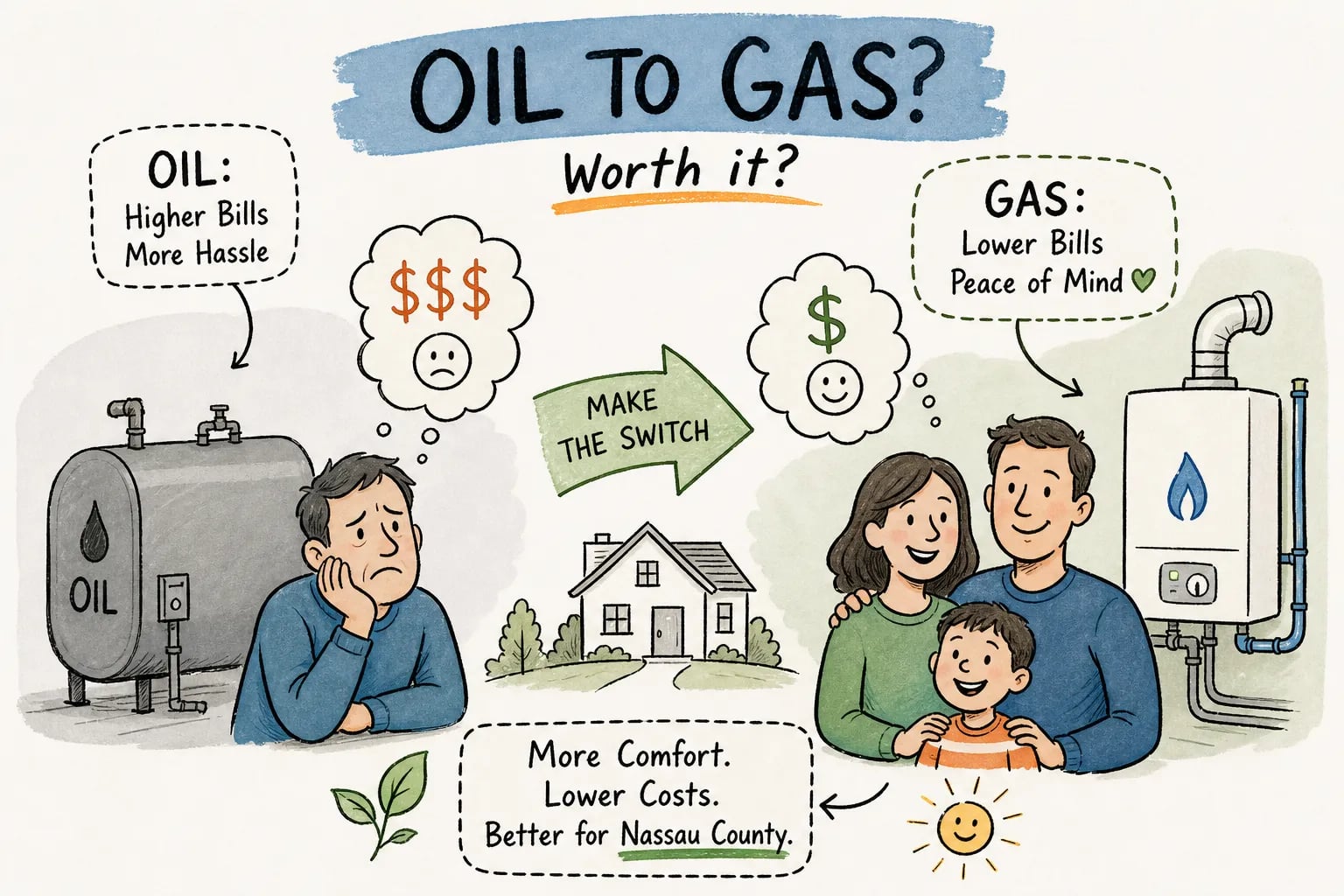
You hear it at the hardware store, at a neighbor’s cookout, maybe from a coworker who can’t stop talking about his January utility bill. “We finally switched to gas.” It sounds simple, like flipping a switch. For Nassau County homeowners who spent $3,000 or more on heating oil last winter, the appeal is obvious. But if you’re asking is it worth switching from oil to gas heat in Nassau County, the answer isn’t just whether gas is cheaper to burn. It often is. The real question is whether the math of getting there works for your specific house, your street, and your timeline.
This article gives you actual Nassau County numbers for 2026 so you can work through that question yourself, without waiting on a contractor’s estimate. We’ll cover what the conversion really costs, what you can honestly expect to save, which rebates are still on the table this year, and the situations where staying on oil is the smarter financial call.
Is it worth switching from oil to gas heat in Nassau County? Costs and payback
The base cost: equipment and installation
For most Nassau County homes in 2026, the realistic all-in range for a full oil-to-gas conversion is $9,000 to $15,000. Straightforward jobs, where gas already runs to the street and the system is a clean boiler swap, can land closer to $7,500. More complex projects, especially those involving underground tank removal, new gas service lines, or chimney liner work, can reach $18,000 or more.
The two biggest line items are the new gas boiler or furnace ($4,500 to $14,000 depending on efficiency rating and system type) and installation labor ($1,500 to $5,000). Together, those two line items can make a quote look complete. Then the additional costs start showing up.
The extra charges most contractors don’t lead with
A natural gas hookup in Nassau County from the street runs $1,500 to $5,000 on its own, and that number moves significantly depending on how close the gas main sits to your property. Oil tank decommissioning and removal adds another $500 to $3,500. Permits, venting work, and chimney liner upgrades can add several hundred to a couple thousand more on top of that.
Before you get a single contractor quote, check National Grid’s address lookup tool to confirm whether gas service is already available at your street. If the main doesn’t run nearby, an extension can push your total cost to convert oil to gas on Long Island well past $18,000 and dramatically change the payback math. This one step takes five minutes and can save you from budgeting off the wrong baseline entirely.
Realistic savings and the honest payback math
How much you can expect to save each year
A typical Nassau County household burning 800 to 1,000 gallons of heating oil per season currently spends roughly $3,200 to $3,500 annually on fuel. An equivalent gas-heated home generally runs $1,300 to $1,500 for the same heat output. That puts annual fuel savings in the range of $1,700 to $2,000 for most households, with some estimates climbing higher depending on usage and how oil prices move in a given year. Gas systems also carry lower routine maintenance costs, which adds a modest amount to that figure over time.
What the payback period actually looks like
The math is straightforward. At $10,000 in total conversion cost and $2,000 in annual savings, payback takes 5 years. At $13,000 with $1,700 in savings, it stretches past 7 years. The honest middle-ground estimate for most Nassau County homeowners is 5 to 6 years, and that assumes the fuel price spread between oil and gas holds steady. If oil prices drop or gas rates tick up, that timeline gets longer.
If you’re planning to sell or move within the next 4 to 5 years, the numbers are unlikely to work in your favor. You’d probably exit before recovering what you put in, and a conversion doesn’t reliably add equivalent resale value to offset the upfront cost.
Rebates and incentives for gas conversion in NY available in 2026
What National Grid currently offers Nassau County homeowners
The primary rebate for oil-to-gas conversions in Nassau County runs through National Grid’s residential rebate program. Rebate amounts vary based on the equipment you install: a condensing hot water boiler with AFUE above 94% qualifies for $1,200, while lower-efficiency boilers and furnaces qualify for $400 to $800 depending on ratings and motor type. To claim it, keep your final invoice, model numbers, AFUE rating, contractor details, and proof of the fuel switch. Submit the rebate application through National Grid’s incentive portal and expect processing within roughly 10 weeks.
If your household is income-qualified, NYSERDA’s EmPower+ weatherization assistance and the Smart Energy Loan financing program are worth looking into separately, but they require their own application process.
What no longer applies this year
The federal 25C tax credit for high-efficiency heating equipment expired at the end of 2025 and does not apply to 2026 installations. Don’t build a conversion budget assuming that credit is available, because it isn’t. Similarly, PSEG Clean Heat incentives that show up in online searches apply to heat pumps and electrification upgrades, not oil-to-gas conversions. The National Grid rebate is the primary incentive to plan around for a Nassau County gas conversion this year.
When staying on oil is the smarter financial call
When switching from oil to gas heat in Nassau County doesn’t pencil out
Not every Nassau County address has a gas main close enough to make the hookup cost manageable. If your street needs a service line extension, or if your oil tank is newer and your burner runs cleanly, the financial case for conversion weakens considerably. A homeowner who works through the full cost-and-payback math and concludes the timeline doesn’t line up with their plans is making a sound, defensible financial decision, not avoiding the issue.
A faster way to cut your heating bill right now
For households that decide to stay on oil, the most immediate lever is the price you pay per gallon. Oil Prices Long Island serves Nassau County with competitive per-gallon pricing, COD payment accepted, and no contract required. For a home burning 800 to 1,000 gallons per season, even a modest per-gallon difference between suppliers adds up to real money each year. The savings start on the first delivery and require no upfront investment, no permits, and no waiting on utility schedules. Call and ask for current Nassau County pricing to see what that difference looks like for your address.
Making the call: a simple framework before you commit
Switching from oil to gas heat in Nassau County makes financial sense when gas is already available at your street, your all-in conversion cost lands below $12,000, and you plan to stay in the home for at least 6 to 7 years. If any of those conditions don’t apply, the math changes, and staying on oil while switching to a lower-cost supplier may deliver better value with none of the risk.
Start by running the National Grid address lookup to confirm gas availability. Then get at least two contractor quotes that explicitly include the gas line hookup and oil tank removal in the total, not just the equipment. Apply for the National Grid rebate before or immediately after the project closes. And if the conversion numbers don’t work out, don’t overlook what a supplier switch can do for your annual bill without any of the complexity.
Your heating costs are a variable you can control starting today. Call Oil Prices Long Island for current Nassau County per-gallon pricing: (516) 986-2239.