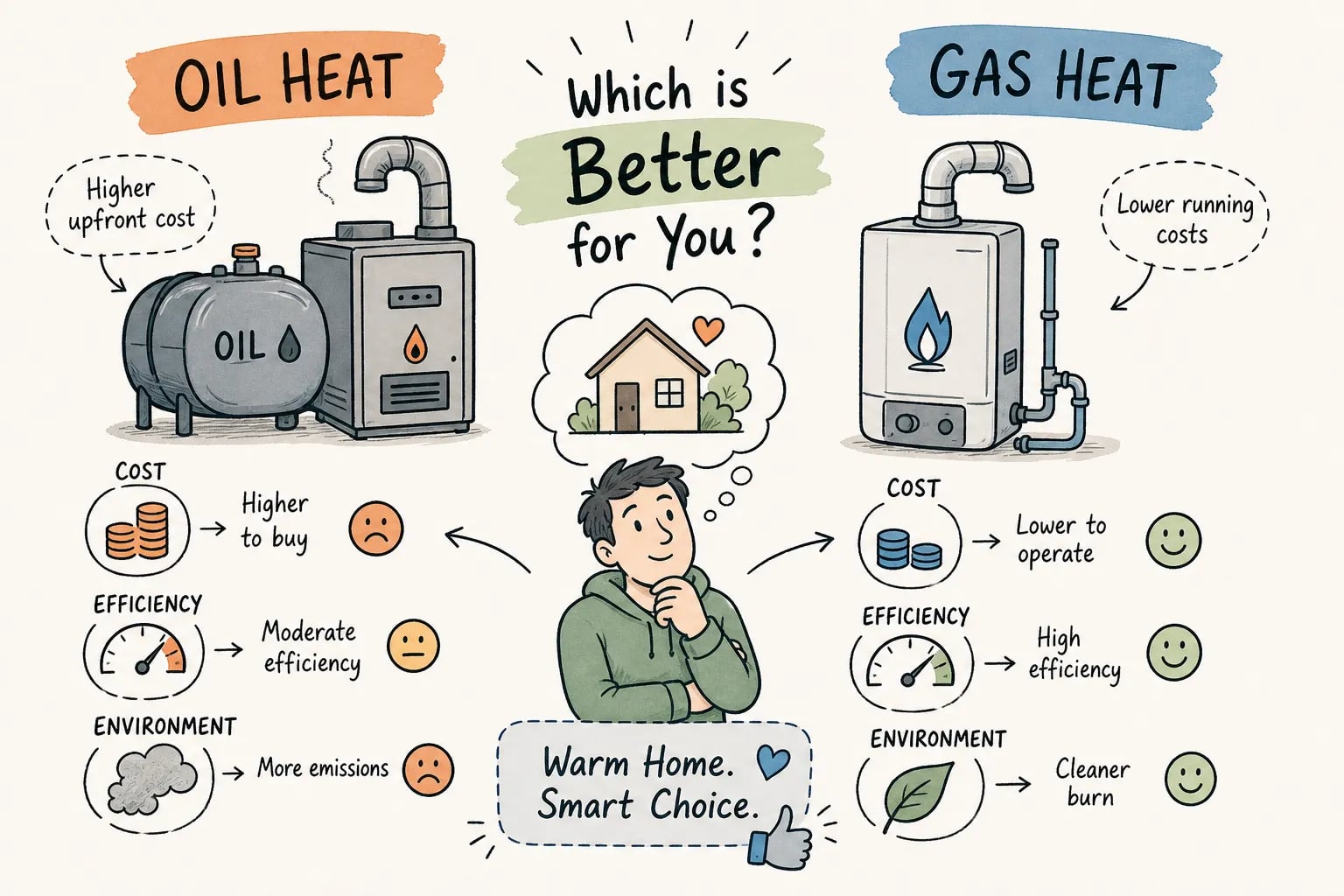
Long Island homeowners are running this exact calculation right now: heating oil sitting above $5.87 per gallon in New York, a gas line at the street, and a gut feeling that something has to change. The oil vs gas heat decision is more complicated than the fuel price alone, though, and making the wrong call can cost you $10,000 or more in the wrong direction.
This comparison covers the four factors that actually determine which fuel wins for your home: annual fuel costs, equipment efficiency, conversion costs, and long-term payback. Long Island has one of the highest concentrations of oil-heated homes in the country, which makes this comparison especially relevant for Nassau and Suffolk County residents. Both fuels have real trade-offs, and the right answer depends on your specific numbers, not a blanket headline from a contractor trying to sell you a new boiler.
Oil vs gas heat: annual fuel costs in 2026
Breaking down the price-per-unit gap
New York residential heating oil averaged $5.87 per gallon in early 2026, according to EIA weekly data. Natural gas for New York residential customers runs roughly $2.19 per therm based on EIA’s May 2026 state pricing. A straight per-gallon vs. per-therm comparison is misleading without factoring in BTU content: one gallon of heating oil contains about 138,500 BTUs, while one therm of natural gas contains 100,000 BTUs. When you normalize for energy output, gas still comes out cheaper per unit of heat delivered.
What a typical household actually spends in a year
An oil-heated home on Long Island burns roughly 800 to 1,200 gallons per year, putting annual fuel spend around $3,200 to $3,500 at current New York prices. A gas-heated home at comparable heating loads typically runs $1,300 to $1,500 per year at New York residential therm rates. The annual gap for a typical home is $1,700 to $2,000 more for oil, and that is before efficiency differences are factored in.
A worked example: normalizing for BTUs and AFUE
Here is the math for a home that uses 1,000 gallons of oil per year at 87% AFUE. That system delivers roughly 120.5 MMBtu of usable heat annually (1,000 gal × 138,500 BTU ÷ 1,000,000 × 0.87). To deliver the same usable heat with a 95% AFUE gas system, you would need approximately 1,268 therms (120.5 MMBtu ÷ 0.95 × 10). At $2.19 per therm, that is about $2,777 per year in gas, compared to $5,870 per year in oil. The fuel-cost gap for this home is roughly $3,093 annually, which puts a $10,000 conversion on a payback schedule of just over three years before rebates.
Oil vs gas heat: equipment efficiency (AFUE ratings)
How oil furnaces and gas furnaces compare on AFUE
AFUE, or Annual Fuel Utilization Efficiency, measures how much of every dollar of fuel becomes usable heat. A 90% AFUE system converts 90 cents of every dollar into actual warmth, the other 10 cents goes up the flue. Modern oil furnaces cluster around 83% to 90% AFUE, with condensing oil boilers reaching the high 80s to mid-90s. Modern natural gas furnaces span 80% to 98%, with condensing models commonly landing in the 90s and the best units approaching 97% AFUE.
How much efficiency difference actually shifts the annual cost
Consider the same home with the same heating load: an oil system at 87% AFUE versus a gas system at 95% AFUE. The gas system delivers roughly 9 percentage points more usable heat per dollar of fuel. That closes the gap somewhat, but it does not eliminate the fuel-price difference. Efficiency matters and should influence your equipment selection, but it does not make oil heat cost-competitive with gas on fuel spend alone in 2026.
The real price tag of converting from oil to gas
What a conversion actually costs in 2026
Most Long Island oil-to-gas conversions run between $6,000 and $15,000 for straightforward swaps. Projects requiring a new gas service line, underground tank removal, or chimney liner work regularly reach $12,000 to $20,000 or more. Here is where the money actually goes:
- New gas furnace or boiler: $3,500 to $12,000 installed
- Gas line piping: $500 to $5,000 or more depending on distance
- Oil tank removal: $50 to $3,000 for above-ground, $1,500 to $5,000 or more for underground
- Permits and inspections: $100 to $500
- Chimney liner and venting upgrades: $500 to $4,000
One factor many homeowners overlook: natural gas is not available at every Long Island address. Confirm service availability at your street before you request a quote.
Payback period: when does the switch actually pay off
At a $1,700 to $2,000 annual fuel savings and a $10,000 average conversion cost, the simple payback period lands at 5 to 6 years. National Grid offers rebates of $1,200 to $2,300 for qualifying 95% AFUE or better units on Long Island. Those rebates can shorten the payback timeline meaningfully. What extends it: higher conversion quotes, lower oil prices, or switching to a more competitive oil supplier before the project starts.
Emissions and ongoing maintenance: the non-cost factors worth knowing
Emissions: how the two fuels compare
Heating oil produces approximately 163 lbs of CO2 per MMBtu; natural gas produces approximately 117 lbs per MMBtu, a 30% to 40% higher emissions rate for oil under standard combustion. Ultra-low-sulfur and bio-blended heating oils narrow that gap somewhat, but standard heating oil still carries a clear emissions disadvantage for homeowners who weigh environmental impact alongside cost.
Maintenance differences to factor into your long-term budget
Oil systems require annual tune-ups and burner cleaning, averaging $150 to $300 per visit. Gas systems typically need service every two years under good operating conditions, averaging $80 to $200 per visit. Over 10 years, that difference typically adds up to $500 to $1,500 more for oil. Neither system is maintenance-free, but gas carries a modest long-term service cost advantage worth factoring into your total cost of ownership.
How to make your call: stay on oil or make the switch?
When switching to gas heat makes clear financial sense
A conversion makes strong financial sense when several conditions line up at once: gas service is available at your street, you already need to replace your oil system (so you are comparing new-equipment costs either way), your actual conversion quote produces a payback period under 6 years, and National Grid rebates meaningfully reduce your out-of-pocket cost on a qualifying high-efficiency unit.
Why many Long Island homeowners choose to stay on oil (and how to make it work)
If your oil equipment is newer, your payback period stretches past 6 to 8 years, or gas service is not available at your address, staying on oil is often the smarter short-term move. The biggest lever you have as an oil-heat homeowner is the per-gallon price you pay, and that varies dramatically by supplier. Long Island homeowners who compare per-gallon rates across suppliers can significantly reduce the annual cost gap that makes gas look so appealing on paper.
Oil Prices Long Island serves both Nassau and Suffolk County with competitive per-gallon pricing, COD payment, and no long-term contracts. Before you commit to a $10,000 to $15,000 conversion, it is worth checking your current rate against what a low-price local supplier can offer. You can reach the Nassau County line at (516) 986-2239 or the Suffolk County line at (631) 714-2999.
The bottom line
When weighing oil vs gas heat, the decision comes down to a conversion-cost vs. fuel-savings math problem, and the answer is different for every home. Natural gas is cheaper to run annually and produces fewer emissions. Heating oil requires no conversion cost and may still be the better financial choice when your payback period stretches well past 6 years or when gas service is not available at your address.
For Long Island homeowners on oil heat, the smartest immediate move is to review what you are currently paying per gallon. If you are overpaying now, closing that gap costs nothing and delivers savings right away. A competitive oil price does not require a new fuel system, a contractor, or a permit. It just requires a phone call to the right supplier.
Frequently asked questions: oil vs gas heat on Long Island
Is natural gas always cheaper than heating oil?
At current 2026 prices in New York, gas delivers heat at a lower annual cost for most homes. That said, the gap narrows when oil homeowners shop their per-gallon rate aggressively, and conversion costs can take years to recover through fuel savings alone.
How long does an oil-to-gas conversion take?
A straightforward swap, existing gas service at the street, above-ground tank, no major venting work, typically runs one to three days. Projects requiring new gas service from the main, underground tank removal, or chimney relining can stretch to one to three weeks depending on permit timelines and contractor scheduling.
Are there rebates available for oil-to-gas conversions on Long Island?
National Grid offers equipment rebates of $1,200 to $2,300 for qualifying high-efficiency gas systems (95% AFUE or better) on Long Island. Check current program availability directly with National Grid, as rebate amounts and eligibility requirements change periodically.
What about bio-blended heating oil and emissions?
Blends such as Bioheat use a mix of ultra-low-sulfur heating oil and renewable biodiesel. Higher blend percentages (B20 and above) can meaningfully reduce carbon emissions compared to standard No. 2 oil, making oil heat a more competitive environmental option for homeowners who prefer to stay on their current system.