Most homeowners inherit their heating system when they buy a home. Whatever’s in the basement is what you’ve got, and while that’s fine, it doesn’t mean you’re locked in forever or that you can’t make smarter decisions about what you spend every winter. Understanding your home heating options matters for budgeting, knowing when an efficiency upgrade actually pays off, and deciding whether switching fuels is worth the disruption.
For Long Island homeowners specifically, where roughly 59% of homes in Nassau and Suffolk County run on heating oil, that last question comes up constantly. This article walks through the five main home heating options, what they actually cost, and how to think about the right fit for your home and climate.
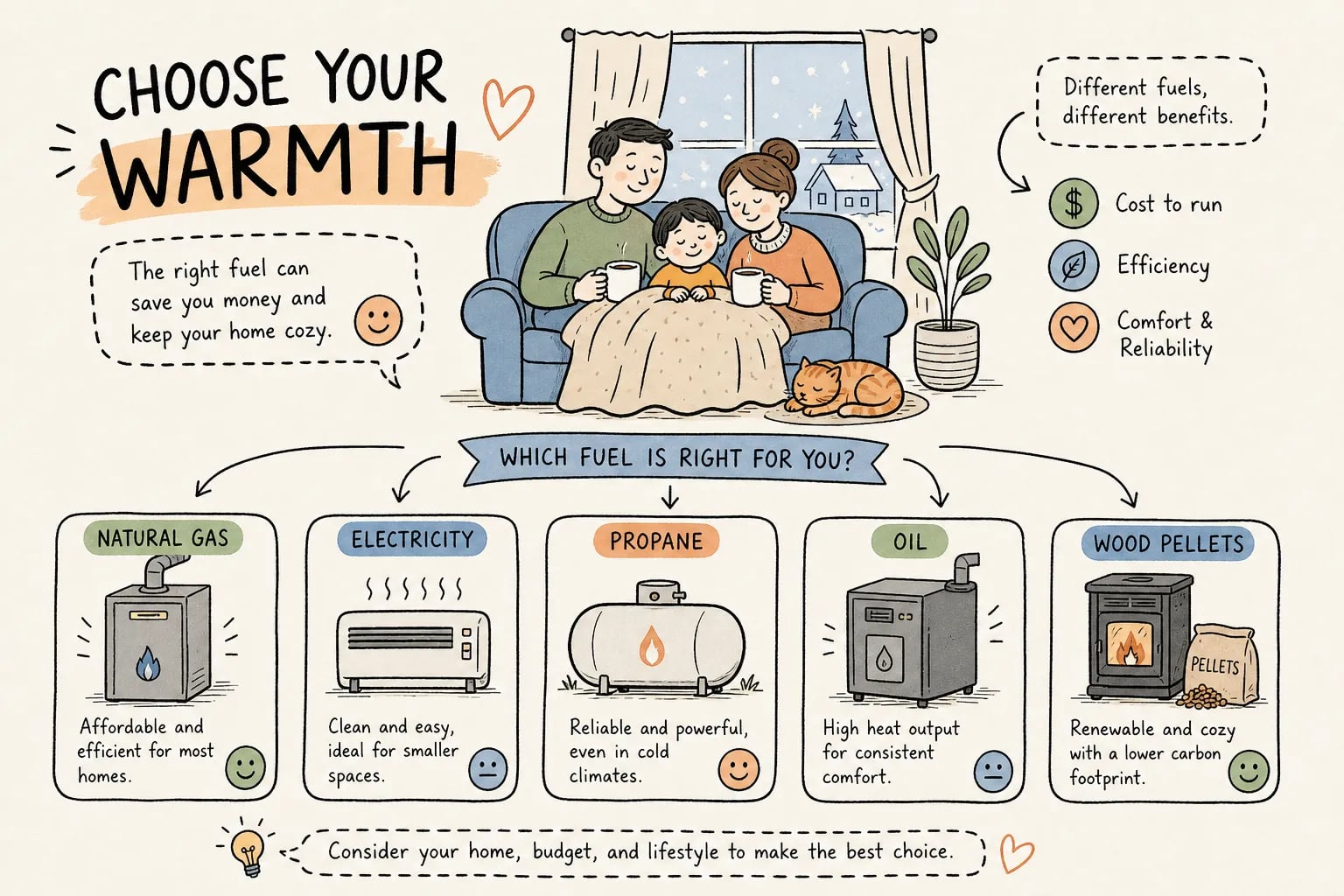
Home heating options, the five main fuel types explained
Every residential heating system does the same job: it converts an energy source into warmth and distributes it through your home. The differences come down to fuel type, equipment, and how that equipment moves heat around.
Heating oil burns in a furnace or boiler, which then heats either air (forced through ducts) or water (pumped through radiators or baseboard units). It’s the most common fuel type across much of the Northeast, where natural gas infrastructure never reached many suburban and rural areas. Long Island is a textbook example: according to regional energy data, roughly 59% of Nassau and Suffolk County homes heat with oil, placing it among the highest oil-heating concentrations in the country.
Natural gas works the same way as oil in terms of equipment, but the fuel is piped directly into your home from a utility line. According to EIA data, it’s the most common fuel type nationally and tends to be cheaper per BTU than oil in many markets. The catch is availability: if there’s no gas main on your street, connecting to it is a major project in itself.
Propane functions like natural gas but is stored in a tank on your property. It’s the practical choice for rural areas without gas lines. Electric resistance heat runs through baseboard units or heating coils and requires no fuel delivery, but it’s expensive to operate because electricity rates make it the costliest way to generate heat at scale. Both propane and electric resistance work well for smaller spaces or as supplemental heat sources.
Heat pumps work differently from the others. Instead of generating heat by burning fuel, they move heat that already exists in outdoor air or the ground. Air-source heat pumps pull warmth from outside air even in cold weather. Geothermal heat pump systems pull it from underground. Both run on electricity, but they deliver significantly more heat per unit of energy than electric resistance coils, making them worth a closer look when evaluating home heating options for the long term.
Compare home heating options by cost
Installation costs and operating costs tend to move in opposite directions, and that tension is where most homeowners get tripped up. The cheapest system to install is usually the most expensive to run year after year.
Electric resistance systems cost $2,000, $6,000 to install, the lowest of any option. Annual operating costs, however, run $1,200, $4,800 depending on home size and local electricity rates. A gas furnace or oil boiler runs $3,000, $10,000 to install and about $1,000, $2,000 per year in most markets. Air-source heat pumps cost $6,000, $15,000 upfront with annual operating costs of $800, $1,400. Geothermal systems require a $20,000, $45,000 investment upfront but can run as low as $400, $800 per year, making them the most efficient long-term option if you can absorb that initial number.
What Long Island oil users actually pay
For Long Island oil users, the math gets specific fast. The average home here burns 700, 900 gallons per year. With the 2025, 2026 seasonal average running close to $4.94 per gallon, that’s roughly $3,500, $4,400 per heating season at typical consumption. The per-gallon rate you pay has a direct, immediate impact on that number, which is why price shopping matters before considering any larger system change.
Which system fits your climate and home situation
Northeast winters shape what actually works reliably, and climate matters more than most homeowners account for when comparing home heating options.
Oil and gas furnaces and boilers handle extreme cold without compromise. Cold-climate heat pumps have improved significantly in recent years. Real-world performance data, including testing tracked by programs such as NEEP’s cold-climate product list, puts median efficiency around 1.9 COP in the 0, 5°F range, meaning they maintain useful output even below 10°F. They can be a legitimate primary heating source when properly sized. In sustained subzero cold, though, most installations benefit from a backup heat source, which is why dual-fuel setups pairing a heat pump with a gas or oil system are increasingly common.
Furnace vs. heat pump: which works best in a Northeast winter?
In milder climates, heat pumps can carry the full season on their own. Ductless mini-splits work especially well in older homes without existing ductwork, providing both heating and cooling from a single system. If your winters rarely drop below 20°F, a properly sized heat pump alone can cover the full season efficiently. In a Long Island climate, where temperatures regularly hit the single digits or below, a furnace vs. heat pump decision usually lands on a dual-fuel setup or a high-efficiency boiler heating system rather than a standalone heat pump.
Radiant floor heating is another alternative worth noting for homeowners doing major renovations. It delivers consistent, even warmth and pairs well with boiler heating systems or, in some configurations, with heat pump water heaters. The upfront cost is substantial, but comfort levels are consistently high.
Already on oil heat on Long Island? Run the real numbers first
Switching from oil to gas or a heat pump is a legitimate option for some homeowners. It’s also a major financial commitment that’s easy to underestimate.
A full oil-to-gas conversion in Nassau or Suffolk County typically runs $7,500, $20,000 or more when you factor in the new boiler or furnace, gas line installation, oil tank removal, permits, and venting work. That range increases further if the gas main isn’t already at your street. Heat pump conversions carry their own costs: new equipment, possible electrical panel upgrades, and duct modifications if the system requires them. Payback periods measured against heating bill savings alone can be long, often many years, depending on fuel prices, conversion cost, and the incentives available to you.
The fastest way to cut your heating bill without a five-figure project is to lower your per-gallon cost. If your oil system is running well, the lever that moves your actual spending most immediately is who you buy from and what you pay per gallon. Oil Prices Long Island serves homeowners across Nassau and Suffolk County with competitive per-gallon pricing, with no contracts required and cash-on-delivery payment, no credit accounts, no service agreements, and no long-term commitments.
Three factors that determine the right heating system
There’s no universally best heating system. The right answer depends on where you live, what equipment you already have, and how long you plan to stay in the home. A geothermal system is worth the investment for a forever home with the budget to support it. A heat pump conversion becomes a strong candidate when your existing system is at end of life and your climate supports it. And when your current oil system is running well, the most immediate savings opportunity often isn’t a system replacement at all, it’s the price you pay per gallon.
When weighing home heating options for a Long Island home, the math usually points to the same first step: find a lower per-gallon price before exploring a system replacement. To find out what heating oil costs right now in Nassau or Suffolk County, call Oil Prices Long Island directly. Suffolk County: (631) 714-2999. Nassau County: (516) 986-2239. No contract required to start.