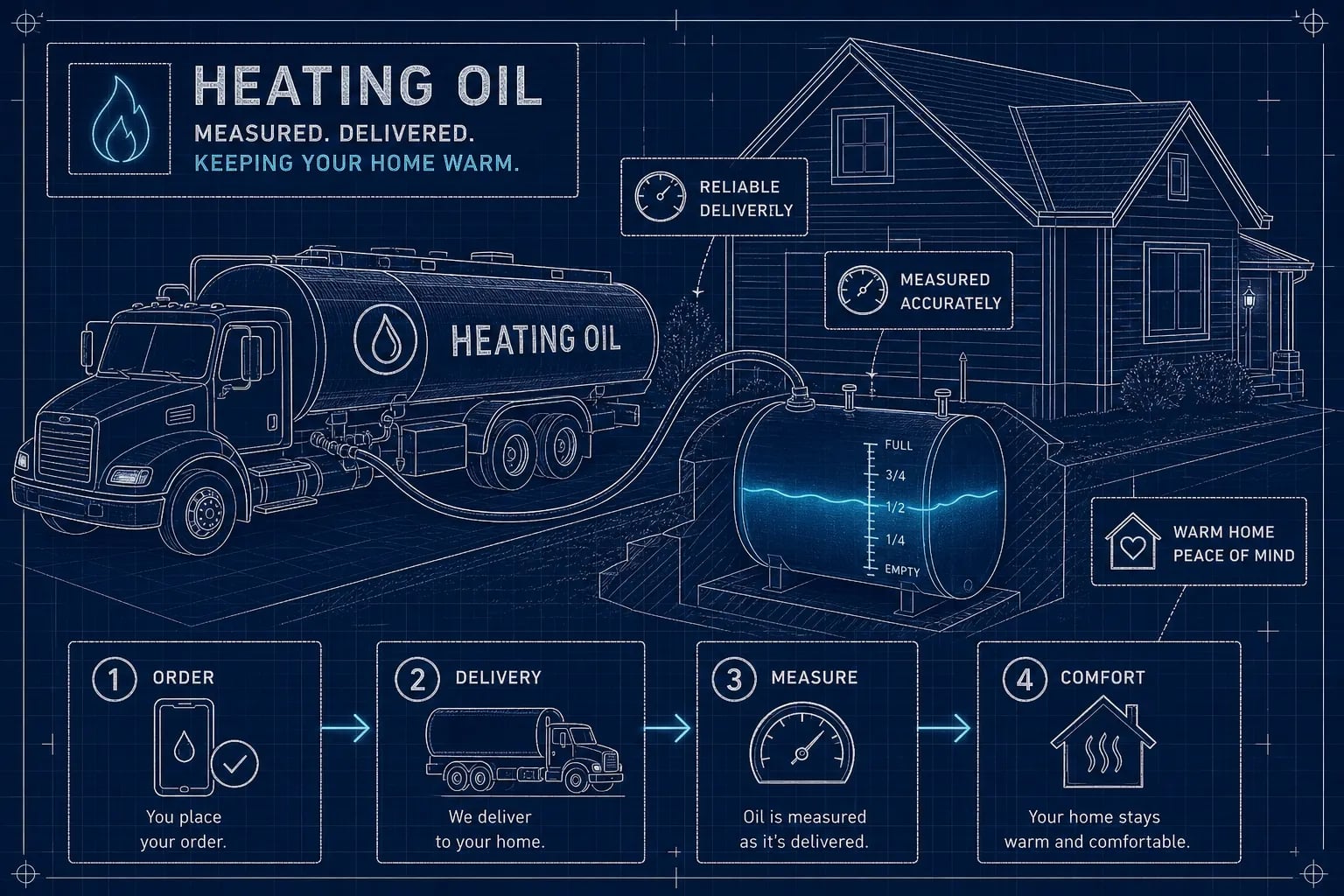
The delivery truck pulls up, the driver connects the hose to your fill pipe, and about fifteen minutes later you get a slip of paper with a number on it. Most homeowners glance at the gallon figure, nod, and go back inside. That works fine until the number is wrong.
Understanding how home heating oil is measured and delivered gives you real protection. You’ll know what the meter on that truck is actually doing, what your delivery ticket must include by law, and exactly how to cross-check the gallons you paid for. None of this is complicated, and taking two minutes at delivery time can save you real money.
The sections below cover the unit of measurement and why it matters, how the truck meter physically records your delivery, and what steps confirm the number on your ticket is accurate. Providers who operate transparently, like Oil Prices Long Island, hand you a clean, itemized ticket with nothing to decode. What you learn here makes reading that ticket straightforward.
How home heating oil is measured and delivered: the basics
Residential heating oil in the United States is quoted, delivered, and billed by the US gallon. One US gallon equals 3.785 liters, but you’ll never see liters on a residential delivery ticket. Retail billing is based on volume, not weight, so the figure on your ticket is always a gallon count.
A standard residential tank holds 275 gallons. A typical delivery runs anywhere from 100 to 200 gallons depending on how low the tank was when the truck arrived. Those numbers matter because #2 heating oil delivers approximately 138,500 BTUs per gallon, meaning even a 10-gallon discrepancy represents real heat and real dollars walking out the door. Each gallon on that ticket has specific energy value, which is exactly why verifying the count is worth your attention.
Suppliers and homeowners who want tighter control over deliveries sometimes track heating degree days (HDD) alongside a property-specific K-factor, a calculated ratio of gallons consumed per heating degree day. Together, these figures let a supplier predict roughly when your tank will need a fill and how many gallons to expect. You don’t need to calculate HDD yourself, but knowing the concept explains why an automatic-delivery account can arrive on schedule even when you haven’t called. Understanding the full heating oil delivery process starts with these fundamentals.
How the truck meter physically measures what goes into your tank
The device doing the measuring is called a positive displacement meter, and it works by physically trapping a fixed pocket of oil and counting how many times that pocket passes through the chamber. Internal gears, rotors, or pistons isolate a known volume with each cycle. The register totals those cycles and converts them directly into a gallon figure. The meter isn’t estimating flow from pressure or speed; it’s counting discrete physical volumes of oil.
Under NIST Handbook 44, these meters must be calibrated, tested, and sealed before use. The maintenance tolerance for vehicle-mounted liquid fuel meters is 0.5% of the measured quantity. On a 150-gallon delivery, that means a properly calibrated meter should be accurate to within about three-quarters of a gallon. State weights-and-measures inspectors test meters periodically, and drivers are not permitted to break the seal and adjust the meter themselves.
Newer trucks use electronic meters that record flow digitally and print the ticket automatically at the end of the delivery. The measurement principle is identical, but the printed output is cleaner and less prone to misreading. Either way, the meter must register zero before pumping begins, and the ticket must be inserted into the meter before the first drop of oil flows.
What your delivery ticket must show
In New York State, a compliant heating oil delivery ticket is required to include specific fields. A ticket missing any of these fields is harder to dispute later. Here’s what must appear:
- Date of delivery
- Name and address of the seller
- Name and address of the buyer
- Grade of fuel delivered (typically #2 heating oil)
- Quantity delivered in gallons
- Price per gallon
- Total price
Many tickets also carry a serial or sales sequence number and driver identification. New York State requires the seller to keep a copy for one year. If the total price is omitted at delivery, the seller must provide it in writing within five days.
Oil Prices Long Island issues straightforward, itemized tickets with no hidden line items. Customers in Nassau and Suffolk County see the per-gallon price, the gallons delivered, and the total, nothing else. No contract billing layers, no confusing fee structures. When the ticket is that clean, verification takes about 30 seconds.
How to verify the gallons delivered and spot a short measure
Before the delivery truck arrives, check your tank gauge and write down the reading. After the driver leaves, check it again. The change in level won’t give you a precise gallon count because residential tank gauges aren’t precision instruments, but a rough match should align with what the ticket shows. A 150-gallon delivery on a tank sitting at a quarter should bring you close to three-quarters full. A large discrepancy is worth investigating.
For a more precise check, use a calibrated dipstick inserted straight down through the fill port until it touches the tank bottom. Pull it out and note the wet-line depth on a piece of tape affixed to the stick, then reference your tank’s capacity chart to convert the change in depth to gallons. This method is especially useful on a first delivery to a new tank where the gauge hasn’t been verified. Marking the wet-line depth after each delivery gives you a reliable reference point for the next fill.
Confirming how home heating oil is measured and delivered at your property
If the ticket figure seems significantly off from your gauge or dipstick reading, contact the supplier immediately and keep your copy of the delivery ticket. In New York State outside New York City, short-measure complaints go to the New York State Bureau of Weights and Measures. Inside the five boroughs, the NYC Department of Consumer and Worker Protection handles meter inspections. Document the date, driver, and the meter reading shown on the ticket. A reputable supplier will review their truck meter calibration records promptly.
Getting deliveries right every time
Heating oil is measured in US gallons, recorded by a calibrated positive displacement meter, and documented on a ticket that must include specific fields under New York law. Checking the ticket, noting the tank gauge before the truck arrives, and confirming the meter started at zero gives you everything you need to verify any delivery accurately, and it takes about two minutes.
The heating oil delivery process doesn’t have to feel like detective work. When your supplier hands you a clean, itemized ticket showing a clear per-gallon price with nothing extra to decode, verifying how home heating oil is measured and delivered to your home is simple. Oil Prices Long Island operates exactly that way across Nassau and Suffolk County, no contracts, no hidden fees, and cash on delivery accepted. Call (631) 714-2999 for Suffolk County or (516) 986-2239 for Nassau County to schedule your next delivery.