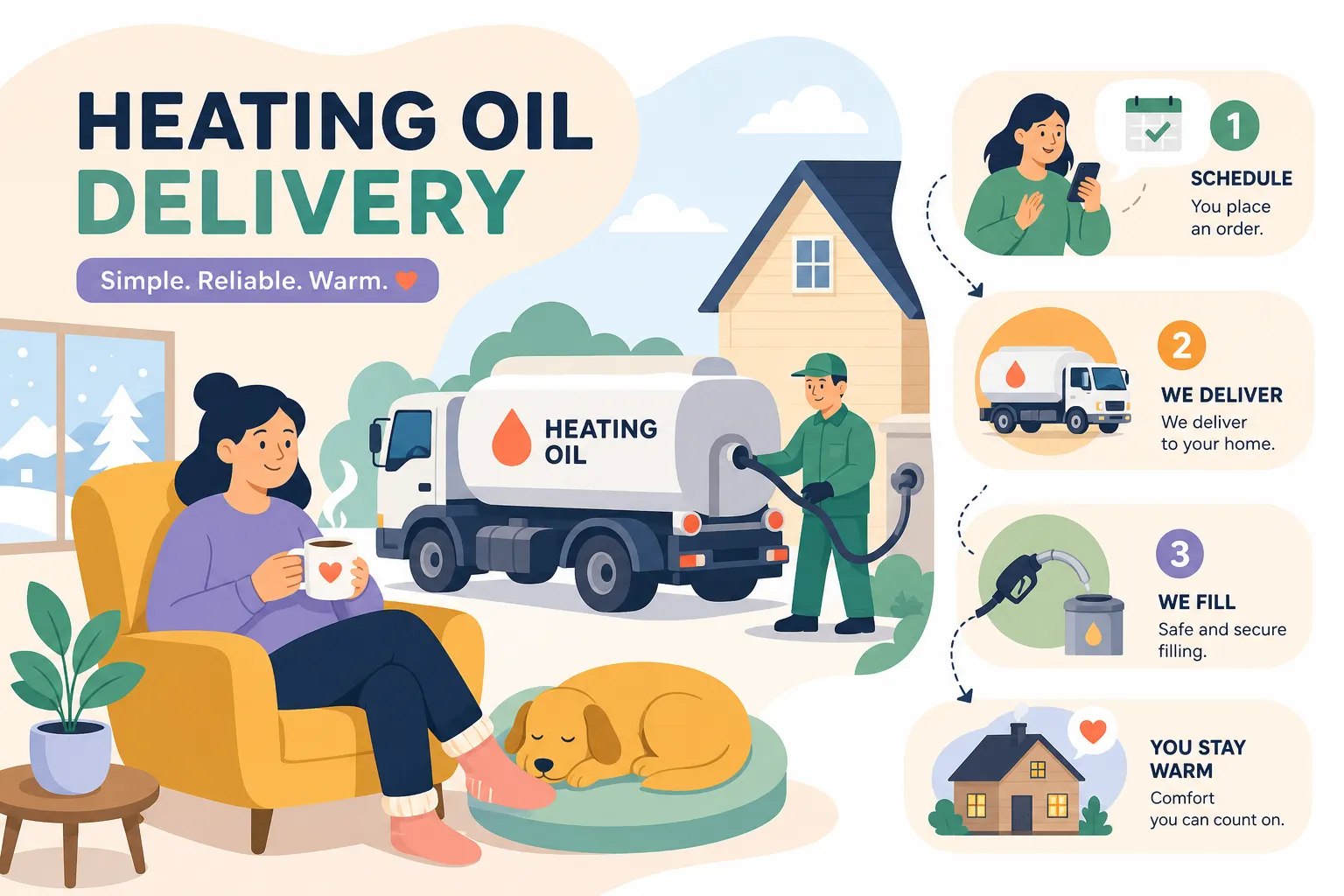
How does residential heating oil delivery work step by step? Picture this: you glance at your oil tank gauge on a January morning. The needle is hovering near the quarter mark, and you realize you have no idea what actually happens between calling your supplier and hearing that familiar gurgle of oil filling your tank. Many Long Island homeowners find themselves in that spot at least once. The reassuring news is that the residential heating oil delivery process follows a clear, predictable sequence in the vast majority of deliveries, whether you order from a local COD provider like Oil Prices Long Island or any other supplier in Nassau or Suffolk County.
Call Us Now for the Lowest Oil Price on Long Island!
Suffolk County (631)714-2999
Nassau County (516)986-2239
By the time you finish reading this guide on how heating oil delivery works step by step, you will know exactly how to place an order, how to prep your property, what the driver does from the moment the truck pulls up, and how payment works at the end. No more guessing, no more surprises.
Step 1: How residential heating oil delivery works, placing your order
Will-call delivery: ordering on your own terms
With will-call heating oil, you take responsibility for watching your tank gauge and contacting the supplier before things get critical. The standard rule of thumb is to call when the gauge hits the quarter-full mark. Waiting longer during peak winter demand risks running into a backlog, and emergency deliveries often carry significant extra fees. Will-call gives you full flexibility since you are not locked into any single supplier and can shop for the best per-gallon price each time you order. For a quick comparison, see a practical overview of will-call vs automatic oil delivery.
Automatic delivery: letting your supplier track the math
Automatic heating oil delivery takes the monitoring off your plate entirely. Suppliers use a system built around two numbers: your home’s K-factor and local heating degree days (HDD). The K-factor measures how many degree days pass per gallon of fuel your home consumes.
HDD tracks daily heating demand based on how far the outdoor temperature drops below 65°F. When the accumulated degree days reach the threshold tied to your K-factor, the system schedules a delivery before your tank runs low. This method is convenient, but it typically requires enrolling in a service agreement with the supplier, so read any paperwork carefully before you sign. If you want more specifics for Long Island homeowners, check out Automatic Heating Oil Delivery for Long Island Homes.
Estimating gallons: matching your order to your tank
The two most common residential tank sizes on Long Island are the 275-gallon unit (which holds roughly 225 to 250 usable gallons) and the 550-gallon unit (which holds around 500 gallons). Ordering a “fill-up” means the driver pumps until the tank is full; a specific-gallon order stops at whatever number you request. If you are a first-time customer, ordering a fill-up is generally recommended so your supplier can record a baseline and start building an accurate delivery history, the foundation of any reliable K-factor calculation.
Step 2: How the oil delivery process works, getting your property ready
Clearing the path from the street to your fill pipe
Before the truck rolls up, move any vehicles out of the driveway and clear snow, ice, and debris from the walkway leading to your fill pipe. The fill pipe is the capped metal pipe coming out of your foundation wall or rising from the ground, and the driver needs a safe, unobstructed path from the truck to that connection point. Skipping this prep step is a common reason a delivery gets turned away. If there is a dog in the yard or a locked gate, note that in your order instructions so the driver is not caught off guard.
Aboveground vs. underground tanks: what the driver needs to know
Aboveground tanks, like the classic 275-gallon basement or garage unit, have a fill pipe that is straightforward to find and access. Underground tanks have a fill pipe that protrudes from the ground, sometimes hidden under mulch or landscaping near the foundation. If you have an underground tank and this is your first delivery, mark the fill pipe with a small flag or stake so the driver spots it without delay.
You do not need to be home for most deliveries as long as the fill pipe is clearly accessible and any special instructions are already on file with the supplier.
Step 3: What happens from the moment the driver pulls up
Arrival, safety checks, and connecting the hose
The driver parks the truck, sets the brake, and locates both the fill pipe and the vent pipe before touching anything else. A quick visual inspection covers the pipes and tank exterior for signs of damage or leaks. Once everything checks out, the driver unreels the delivery hose and positions absorbent drip pads at the connection point before attaching the nozzle to the fill pipe. Those pads are standard safety procedure, not a red flag. For a detailed, external walkthrough of the full delivery sequence, see this step-by-step heating oil delivery process.
The pumping process and the vent whistle
As oil flows into the tank, it pushes air out through the vent pipe, and that moving air activates a small alarm called the vent whistle. The driver listens to that whistle throughout the fill. When the tank approaches capacity, airflow stops and the whistle goes quiet, that silence is the signal to stop on a fill-up order. For a specific-gallon order, the metered pump cuts off automatically at the requested amount.
The “no whistle, no fill” rule is non-negotiable: if the vent alarm is not functioning, a professional driver will refuse to complete the delivery rather than risk an overfill or spill. This is one of the most important safety checkpoints in the entire oil tank fill procedure.
Completion: disconnecting, documenting, and leaving the property
After the pump stops, the driver disconnects the hose, replaces the fill pipe cap, rewinds the hose back onto the truck reel, and prepares a delivery ticket. That ticket shows the exact gallons pumped and the price per gallon. If you are not home, the driver typically leaves the ticket at your door, though some suppliers mail it or follow a different procedure, so confirm the practice with your provider. Check your tank gauge after every delivery and compare the reading to the receipt; if the numbers do not align, call the supplier the same day.
Step 4: Reviewing your receipt and handling payment
What your delivery ticket must show
New York State law requires that every heating oil delivery receipt include the number of gallons delivered and the price per gallon. Most suppliers also include the delivery date, the company name, and the total amount due as standard practice, and you should expect all of those fields on any ticket you receive. Hold onto these slips for the full heating season. They give you a clear record for budgeting purposes. Check with your tax preparer as well, certain heating oil blends may qualify for state or federal home energy credits, and your receipt may serve as the required documentation. If anything on the ticket looks off, call immediately while the details are fresh.
Why COD delivery makes the whole process simpler
Some suppliers require a credit account, a signed service agreement, or a price-lock contract before they will schedule a single delivery. COD providers cut through all of that. The driver delivers the oil, hands you the ticket, and you pay on the spot with cash, check, or card depending on the company. There is no billing cycle, no contract to review, and no credit check. Oil Prices Long Island operates on a full COD basis, which makes them a practical first call for new homeowners and landlords managing multiple properties who want oil when they need it, without the paperwork or long-term commitments.
What to remember for every delivery going forward
Understanding how residential heating oil delivery works step by step puts you in control of the whole process. It comes down to five stages: place your order (will-call or automatic), prep the property, let the driver do their work, review the receipt, and pay on delivery. That knowledge is especially valuable during a stretch of bitter cold when many providers across Nassau and Suffolk County are running packed schedules and response windows can be tight. For a broader local perspective on costs and logistics you can review Long Island Oil Delivery: How It Works and What It Costs.
Call when your gauge hits a quarter tank. Keep the fill pipe clear. Match your receipt to your gauge reading. Following these habits consistently will significantly reduce the risk of ever needing a costly emergency delivery, though no method is entirely foolproof during extreme weather or unusual circumstances. And if you are on Long Island and want the straightest path to a full tank without contracts or credit accounts, Oil Prices Long Island is one call away: Suffolk County (631) 714-2999 or Nassau County (516) 986-2239. If you’d like a broader primer on selecting a delivery partner and service level, see our Guide to Selecting the Ideal Heating Oil Delivery Service.
Frequently asked questions about residential heating oil delivery
How does residential heating oil delivery work step by step for first-time customers?
The process is the same regardless of experience. You place an order (either will-call or automatic), prepare your property by clearing access to the fill pipe, the driver arrives and completes the oil tank fill procedure using the vent whistle as a safety guide, and you receive a delivery ticket and pay on completion. First-time customers are generally encouraged to order a full fill-up so the supplier can establish a usage baseline.
How long does a typical heating oil delivery take?
Most residential deliveries take between 15 and 30 minutes from the time the driver arrives to the time the truck pulls away. Factors like tank size, gallons delivered, and property accessibility can affect that window.
What is the difference between will-call and automatic heating oil delivery?
With will-call heating oil, you monitor your gauge and contact the supplier when you need a refill. With automatic delivery, the supplier uses your K-factor and local HDD data to predict when your tank will need a fill and schedules the truck proactively. Automatic delivery is more hands-off; will-call gives you more control over timing and pricing.
Do I need to be home when my heating oil is delivered?
In most cases, no. As long as the fill pipe is accessible and your account instructions are current, the driver can complete the delivery without anyone present. They will leave the delivery ticket at your door or follow whatever documentation procedure your supplier uses.
What should I do if my delivery ticket looks wrong?
Check your tank gauge immediately after the delivery and compare the reading against the gallons shown on the ticket. If the numbers do not match, call your supplier the same day while the details are still easy to verify. If you need help reading the gauge or interpreting tank markings, consult this external guide on the heating oil tank gauge for step-by-step reading tips.