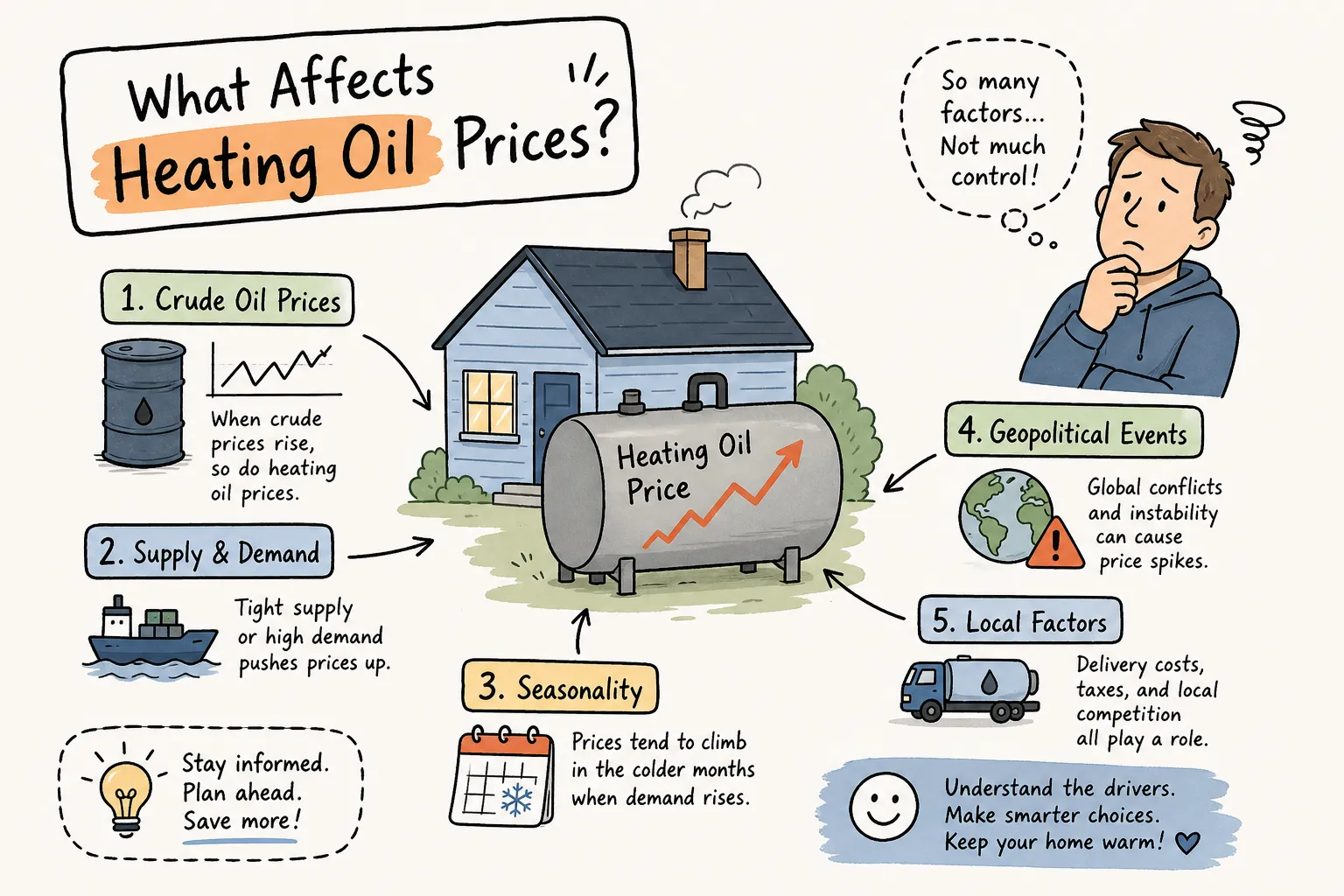
Heating oil prices vary more than most homeowners realize, and the gap can mean real money. The national average for residential heating oil hit $5.535 per gallon as of late March 2026, while Long Island homeowners were paying closer to $4.22 per gallon that same week. That difference isn’t luck or geography alone. It’s the result of several overlapping forces that most homeowners never think about until the bill lands.
If you understand what actually moves the per-gallon rate, you can shop smarter, time your orders better, and stop paying more than you have to. Local suppliers like Oil Prices Long Island monitor these market swings every week, which is exactly why their rates stay competitive across Nassau and Suffolk County. No technical background required. Here’s how it all works.
How Crude Oil Drives Heating Oil Prices
Heating oil (No. 2 fuel oil) is a refined petroleum product, and its price moves in near-lockstep with crude oil. When crude rises due to supply cuts, geopolitical pressure, or refinery constraints, residential heating fuel prices follow within days. Year-over-year data from early 2026 illustrates this clearly: prices were up roughly 50% compared to the same period in 2025, driven largely by upstream crude volatility and tightened distillate supply. For a historical perspective on heating oil price movements, see the heating oil historical data.
But crude prices alone don’t tell the whole story. How much No. 2 fuel actually gets refined and reaches the domestic market matters just as much. When refineries reduce output or export large volumes of distillate fuel oil, domestic supply tightens and retail prices climb, even if crude holds steady. Supply disruptions tied to geopolitical events contributed to sharp price swings in the first quarter of 2026. That’s why home heating oil rates on any given day can look very different from what they were just a few weeks earlier. For a deeper look at market mechanics, consult the Understanding the Home Heating Oil Market.
Your delivery quote reflects global market conditions, not just what’s happening on Long Island. When you see headlines about oil-producing nations cutting output or refinery shutdowns, expect your next per-gallon rate to move accordingly.
Call Us Now for the Lowest Oil Price on Long Island!
Suffolk County (631)714-2999
Nassau County (516)986-2239
Seasonal Heating Oil Prices and Why They Peak When You Need Them Most
Heating oil is a seasonal product, and demand peaks hard between October and March across the Northeast. That seasonal surge draws down regional distillate inventories and pushes retail rates higher at exactly the moment homeowners are placing their largest orders. EIA weekly data from early 2026 shows prices climbing from roughly $3.62 per gallon in early January to over $5.50 per gallon by late March, a steep run that tracks both seasonal demand and tightening supply. Checking a heating oil price forecast each fall can help you anticipate these swings before they hit your budget; for up-to-date commodity metrics see heating oil commodity data.
What this means for your wallet is simple. Homeowners who fill their tanks in September or early October consistently pay less per gallon than those who call in February during a cold snap. This isn’t a prediction about any single year; it’s a pattern confirmed by decades of EIA weekly data. The best time to buy heating oil is before you urgently need it. Waiting until the tank gauge hits red during a stretch of 20-degree nights is the most expensive way to stay warm.
Delivery Zones and Order Size: The Local Cost Factors Most People Overlook
Even within Long Island, heating oil prices are not uniform. Delivery distance, route density, and county-level logistics all affect what a supplier charges. Nassau County and Suffolk County can carry different baseline rates depending on driver travel time, stop density, and local competition. More rural parts of Suffolk County, where stops are spread further apart, often carry slightly higher delivered prices than densely served neighborhoods closer to the county line.
Order size is one of the most underappreciated cost drivers in home heating oil delivery. Small deliveries under 100 gallons carry the highest per-gallon cost because fixed stop, handling, and fuel fees get spread across fewer gallons. Orders above 300 gallons dilute those fixed costs significantly, bringing your effective cost per gallon down. Before you place your next order, ask your supplier specifically about their minimum-order thresholds and what charges apply below that level.
Ask your supplier upfront about these specific charges before you commit:
-
- Fuel surcharges or fuel adjustment fees
-
- Residential delivery fees
-
- Zone or distance-based charges
-
- Emergency or after-hours delivery premiums
-
- Small-order or minimum-delivery surcharges
These charges can quietly close the gap between a supplier advertising a low headline rate and one posting a slightly higher rate with no add-ons. The all-in price per gallon is the only number that actually matters.
What Actually Matters When You Compare Heating Oil Suppliers
Not every advertised rate includes delivery fees, taxes, or surcharges. A supplier promoting a low per-gallon number can easily deliver a higher final bill than a competitor with a slightly higher posted rate and no tacked-on fees. Always ask for an all-in per-gallon quote before committing, and confirm there are no minimum order surprises, zone charges, or automatic delivery contract requirements hiding in the terms.
COD payment options are particularly important for homeowners who want to stay in control of their purchases without locking into annual agreements or maintaining a credit account. Many larger regional suppliers require contracts or automatic top-off programs that price orders based on last season’s rates rather than what the market is doing today. For Long Island homeowners who want to avoid that trap, a no-contract supplier that responds to real-time crude and distillate data is a meaningfully better deal.
Oil Prices Long Island actively monitors crude markets, distillate inventory reports, and regional rate shifts to keep its per-gallon pricing among the most competitive available in Nassau and Suffolk Counties. No contract required, COD accepted, and rates that reflect current market conditions rather than last year’s fixed-price agreement. That’s the practical application of everything covered in this guide. For a step-by-step walkthrough on pricing mechanics, see Understanding Heating Oil Pricing: A Comprehensive Guide.
Putting It All Together Before Your Next Delivery
Four factors drive what you pay per gallon: global crude oil and refinery output, seasonal demand timing, delivery zone logistics, and order size economics. None of these are random, and all of them are predictable to some degree. Homeowners who understand these forces make better purchasing decisions. For regularly updated New York averages you can compare local rates to the NYSERDA monthly average home heating oil prices.
Understanding heating oil prices is the first step toward controlling them. If you’re on Long Island and want transparent, market-responsive pricing without contracts or credit requirements, check current rates at Oil Prices Long Island before you schedule your next delivery. Compare all-in prices across suppliers and ask specifically about surcharges. For ongoing tips, local updates, and rate notices, see our Blog | Best Cheap Oil For Home Heating | Long Island, NY. Order before the winter rush if your tank allows it. Getting your timing right and choosing the right supplier is the most reliable way to keep your heating costs under control through the season.