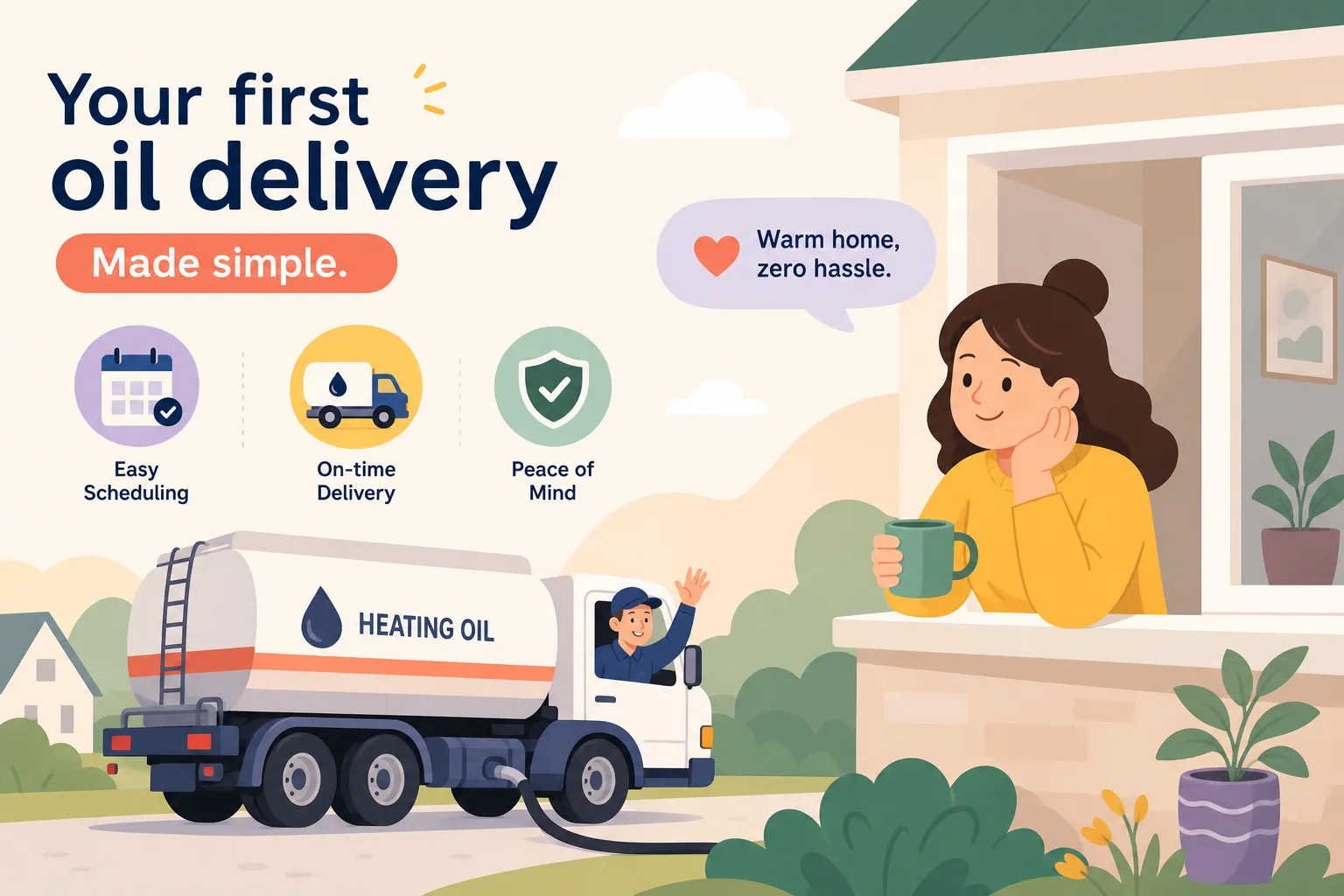
You just bought your first home on Long Island, and somewhere in the basement sits a big metal tank you’re now responsible for. You’ve heard the terms “will-call” and “automatic delivery” thrown around, and you know the gauge on that tank means something; you’re just not sure what to do when it gets low. That uncertainty is completely normal, and the good news is that a home heating oil delivery service is far simpler to work with than most new homeowners expect.
Oil Prices Long Island has built its model around keeping things simple for homeowners in Nassau and Suffolk County, no lengthy paperwork, no service contracts, just fuel at your door when you need it. Here’s a plain-language breakdown of how the whole system works, so you can make a confident decision before your first order.
Call Us Now for the Lowest Oil Price on Long Island!
Suffolk County (631)714-2999
Nassau County (516)986-2239
What a home oil delivery service actually provides
A professional delivery is more than a truck pulling up and filling your tank. When the driver arrives, they connect to your fill pipe outside (or in your basement), pump the fuel in, and leave a delivery receipt showing exactly how many gallons were delivered and the price per gallon you paid. Most providers also have the driver do a quick visual check of the fill pipe area and read your gauge before and after the fill. In most cases, nobody enters your home, the process happens at the exterior fill point, though customers should confirm their fill location with their supplier since some properties have interior setups.
Scheduling works on a route-based system. Oil companies plan their delivery trucks by geographic zone, which means your delivery is typically slotted one to three business days out during normal weather. During a cold stretch in January or February, that window can stretch as demand peaks across the county. Most providers give you a morning or afternoon window rather than a precise arrival time, so plan to be available to receive a slip or payment if you’re on COD. When in doubt, confirm the scheduling details directly with your local provider.
Same-day oil delivery is possible, but it carries a real cost. On Long Island, emergency or same-day service fees typically add $40 to $200 on top of your per-gallon rate. For most households, that premium is completely avoidable with basic planning, which the rest of this guide covers.
Automatic delivery vs. will-call: which one fits your household
Automatic oil delivery programs use something called a degree-day calculation to estimate your usage. The provider tracks daily temperatures, compares them against a base of 65°F, and multiplies that data by your home’s historical burn rate (called a K-factor) to estimate when your tank will reach one-third to one-half capacity. At that point, they schedule a truck without you lifting a finger. For busy households or anyone who travels frequently, this is a genuine convenience. Read more in our Exploring the Benefits of Automatic Heating Oil Delivery.
The price tradeoff between automatic and will-call
The tradeoff is cost. Automatic delivery customers generally pay 20 to 50 cents more per gallon than will-call customers, because the provider absorbs the scheduling and monitoring overhead. In New York, where heating oil averaged around $5.87 per gallon in early 2026, that difference adds up over a full heating season.
Will-call puts you in control. You watch your tank gauge, and when it drops to around 25 to 30 percent, you call your supplier and order the amount you want at that day’s market price. The upside is direct access to current pricing and full control over your delivery schedule. The risk is forgetting to call. A runout means the system shuts down completely, and a technician has to come out to bleed the lines and restart your burner, a service call that is both inconvenient and costly.
Will-call works well for attentive homeowners who check their gauge weekly and want flexibility without a contract. For a vendor’s perspective on the differences between will-call vs. automatic delivery, see that comparison for more detail.
Choosing an oil delivery service plan: minimums, windows, and costs
Regardless of which delivery method you choose, every order is subject to the same minimum-size and scheduling rules. Most heating oil companies on Long Island require a minimum order of 100 gallons, though some providers accept orders as small as 50 gallons. Orders below the minimum often trigger a short-delivery fee ranging from $35 to $100.
Getting the tank math right
For a standard 275-gallon home tank, the gauge at one-quarter full means roughly 69 gallons remaining, well above most 50-gallon minimums, but close enough to the 100-gallon threshold that ordering sooner makes sense. A practical rule: call when the gauge reads one-third full (around 90 gallons remaining) to stay comfortably above any minimum and avoid short-delivery fees entirely.
Delivery windows across Nassau and Suffolk County are generally one to three business days for standard orders placed during moderate weather. Most drivers run routes during standard business hours on weekdays. If you’re on a COD plan, have your payment ready when the truck arrives. Accepted forms typically include cash, money order, or a credit or debit card, depending on the provider. Always confirm payment options when you place your order, since some companies have shifted to card-only transactions.
Payment options and the no-contract advantage
Three payment structures dominate the residential oil market. COD (cash on delivery) means you pay the driver on the day of delivery at the current per-gallon price, no account setup, no credit check, no automatic billing. Budget plans spread your estimated annual fuel cost across 10 to 12 equal monthly payments, smoothing out the winter expense spike. Fixed-rate contracts lock in a price per gallon for the entire heating season, protecting against market surges but eliminating the chance to benefit if prices drop.
For first-time homeowners still learning how much oil they actually burn in a year, a no-contract setup is the most practical starting point. Many larger regional suppliers bundle automatic delivery, service contracts, and price caps into agreements that are difficult to exit mid-season. That’s a significant commitment before you even know your household’s real usage patterns.
Oil Prices Long Island keeps things straightforward. The company offers COD payment with no long-term contracts required, and its pricing covers both Nassau and Suffolk County. You order when you need fuel, pay on delivery, and owe nothing beyond that transaction, a setup that makes sense for a new homeowner who still has a hundred other things to figure out about their home.
Getting your first delivery right
The biggest takeaway: plan ahead. Order when your gauge hits 25 to 30 percent, not when it’s creeping toward empty. That one habit eliminates same-day fees, avoids runouts, and keeps your heating system running smoothly through every cold stretch from November through March.
A quality oil delivery service covers more than just the fuel itself. The scheduling structure, payment flexibility, and minimum-order rules all affect what you pay and how reliably your home stays warm. Understanding those details upfront means you’re not making rushed calls in the middle of a cold snap.
If you’re searching for an oil delivery service near me option in Nassau or Suffolk County and want to set up your first delivery without the hassle of contracts or pressure, Oil Prices Long Island is worth a call. Suffolk County residents can reach them at (631) 714-2999, and Nassau County homeowners can call (516) 986-2239. Clear pricing, flexible payment, and fuel when you need it. For more on choosing a provider, see our Guide to Selecting the Ideal Heating Oil Delivery Service.